Blog

A Very Happy Birthday

Last week was my birthday (39, I have one year left in my 30’s!) and I was overwhelmed by the outpouring of well-wishes from friends, family, and readers all over the world via Facebook, twitter, e-mail, and the like. Literally hundreds of them. Sometimes writing feels like the loneliest gig on the planet, but once in a while I am reminded what a huge family I have thanks to my books, and how fortunate I am. Thank you everyone who took the time to chime in. It means the world to me.

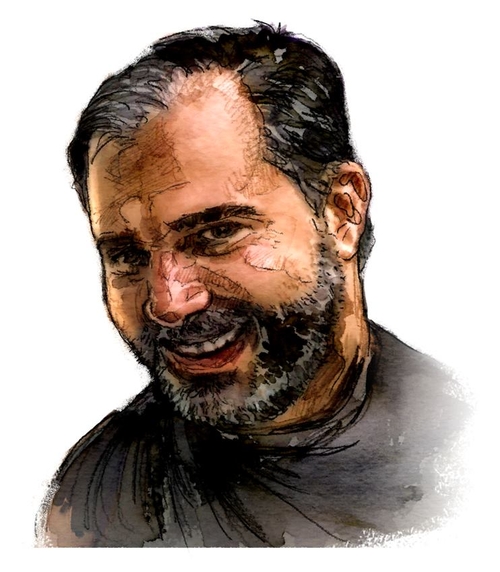
One facebook post in particular stood out … Portuguese graphic novel artist Pedro Pires, who I met in 2010 on my visit to Lisbon, painted an amazing portrait of me! Pedro, you are awesome. Thanks so much!

On top of that, my agent got me a Hungarian book deal for the first three Demon Cycle books on my birthday as well. Win.

Posted on February 16, 2012 at 8:00 am by PeatB
Filed under Fan Art, Fans, Life, Warded Man
2 Comments »

Italian Interview

Posted by Rebecca and Meg

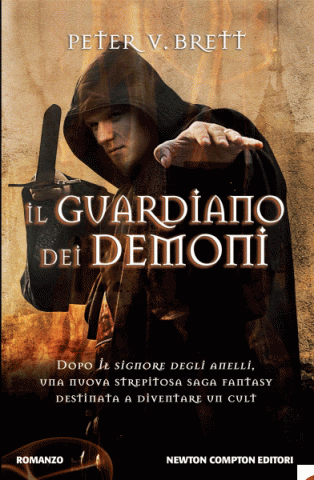
A blog in Italy, by the name of Wonderful Monsters (yes, the name is actually in English), did a cool interview with Peat about Il Guardiano dei Demoni, the Italian version of The Painted Man.

You’ll find some cool stuff in this interview, specifically what Peat thinks about all of the different titles for his books, and what he thinks about Il Guardiano dei Demoni.
You can find the original blog post here. But, if you aren’t quite fluent in Italian yet, read the English version below.

Italian Ciao Radio Interview

Peter V. Brett

What’s the genesis of this book?

The book originally started as a writing assignment in a class I was taking at New York University in 1998. The assignment was to write an original first chapter of a longer fantasy novel. I wrote a short chapter about a young boy named Arlen with wanderlust, but who had never been more than a few hours form home, because he needed to be home behind the magic wards by nightfall, when the demons came out.

I was working on the story from that point on, but something eluded me. I had created the world of demons and ward magic, but that wasn’t enough. I needed to understand how the people in this world responded to the ever-present fear that they were living under.

It wasn’t until years later, after September 11, 2001, that I started to understand fear. I was in New York City that day, and remember how everyone was afraid, but each responded to their fears differently. Some ran away. Others ran towards the scene to watch or offer help. Some people were frozen and indecisive, and others leapt into ill-advised action. This was something I pondered a great deal in the months and years that followed, and I think this heavily influenced the story. It is not a political or cultural commentary, but rather a study of fear and how it affects people.

Did you expect all this interest in your first book?

Not really. Writing is a very private endeavor, and one never really knows how readers will respond to their work. I always wanted to be a professional writer, but I thought it was just a dream and a hobby. I worked very hard on my stories, but even so, I was surprised to even get a literary agent to represent me. When the books sold to a major publisher, it was a dream come true, but even then I was expecting only moderate books. Now I am a bestseller published in 20 languages. I still have trouble believing that and keep expecting to wake up from the dream.

When you really think you will be a writer?

As I said, I wanted to be a writer since I was very young, perhaps nine or ten years old. I didn’t expect it to actually HAPPEN, but writing has always been what I loved to do, and I would keep doing it even if no one was reading.

The Italian name of the book is “The guardian of demons”: what do you think about it? You think it feets with the content of the book?

One of the things an author has to get used to is changing of their titles. Sometimes a publisher will change them before the book is first published, and even then, the name doesn’t always translate well. Even my English title is different in the US than it is in the UK. Even so, I have been very fortunate to have good titles in most every language. I think “The Guardian of Demons” is appropriate. In many translations, the magical wards that hold the demons back are called “guards”, and the story is about a man who tattoos those symbols on his skin.

Let’s talk about The Painted Man. Magic in your book is different from the one we are used to know: how is the genesis of the magic system in your book?

I have read a lot of fantasy novels, and had grown tired of wizards casting spells and throwing fire and lightning about. Magic sets the tone in fantasy stories, and in my opinion, it should enhance the stories rather than simply provide the hero with an easy escape at the end.

The use of magical symbols to ward off evil is not a new idea. It is something that has grown independently in most every culture in human history. What I did was take that idea, and apply a certain amount of science to it, creating hard rules of what it could (and could not) do, so the reader understands the power and isn’t.

In The Painted Man, people are threatened by Corelings: who are they and how can people defend from them?

In the story, mankind has been at war since the beginning of time with demons who live at the core of the world. These creatures, called corelings, cannot abide sunlight, but they come out at night to hunt. They come in different varieties, based on their elemental nature. Flame demons are small and quick and spit fire. Rock demons are large, slow, and incredibly strong and difficult to harm. Wind demons can fly. Et cetera.

Demons are creatures of magic, and are thus extremely difficult to kill. The only true defense is the use of magical symbols called wards that leech away some of the demons’ magic and turn it against them. For a time, humans were at war with the demons, and even winning, but then in a cunning plan, the demons stopped coming to the surface for many centuries, waiting until humans ceased to believe in them and forgot the magic that kept them safe. Only then did the corelings return, killing almost everyone and topping their industrial society. When the story begins, 300 years after this return, humans live in small pockets protected by wards, but the symbols that allow them to fight back are lost to history.

Only 3 children can do something to it seems that nothing can defeat them but the last hope is entrusted to three kids: what’s their role in the story?

The story centers around three characters, Arlen, Leesha, and Rojer, each of whom has been scarred (either physically or emotionally) by a demon event in their childhood that shapes the people they will become.

Arlen, disgusted by the cowardice that leads to the deaths of some people close to him, runs away from home, vowing to become a warrior and find the lost combat wards that will allow people to fight demons once more.

Leesha, whose idyllic small town life is destroyed by the lies of her fiancée, finds her calling in healing after a demon attack leaves many of her townsfolk injured.

Lastly there is Rojer, orphaned when he was only three years old. Rojer is apprenticed to a drunken traveling entertainer, and discovers that his music can affect the corelings in strange ways.

May you tell us something about next book, Desert Spear (we hope soon will be published also in Italy)?

The Desert Spear is focused on a character from The Painted Man named Ahmann Jardir. Jardir was something of a villain in the first book, but the Desert Spear delves into his childhood and shows how the man in the first book was shaped, and how he is, in his own way, just as much a hero as Arlen or Leesha or Rojer. The book also has all of the characters from the first book, and continues their adventures forward. Having finally discovered how to fight the corelings, they are shocked when the demons respond with unexpected cunning.

We have read that this book will be a movie: what can you tell us about that?

The books have all been optioned by director Paul WS Anderson and Producer Jeremy Bolt (Resident Evil, Pandorum, 3 Musketeers). They showed incredible faith in the series right from the start, and offered a bold vision of how it might translate to the screen that impressed me greatly. We are all very excited to work on the project, which is currently in pre-production and being pitched to major studios. Hopefully sometime soon it will move forward.

Finally I leave you a space to send a message to your Italian fans.

My mother is Italian, and told me that while she felt proud for achieving my dream every time I sold a book in any language, the Italian version is the most precious to her. I can’t wait to receive my author copies so I can give her one. So thank you, Italian readers! Your support means a great deal to our family!

In the Mail

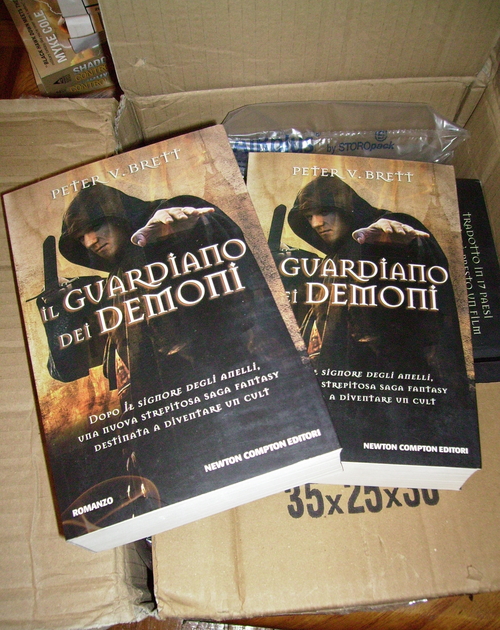
We also just received a whole box of Il Guardiano dei Demoni in the mail the other day. They are looking pretty fancy!
Posted on February 15, 2012 at 8:00 am by Hannah
Filed under Craft, Desert Spear, Fans, Interviews, Rebecca, Warded Man, Writing
1 Comment »

Twilight Dancer Fan Art

Posted by Meg

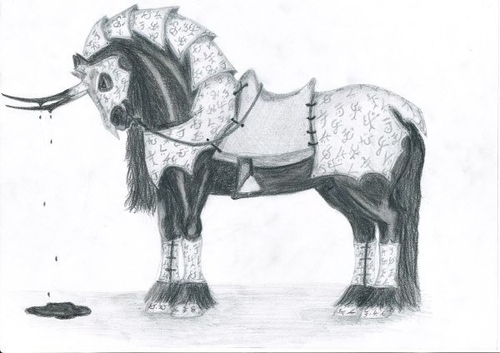
Even though the Fan Art Contest is over and the prizes have been awarded and sent, Peat and I would still love to see your fan art to post here on the blog. Peat received a letter from an Italian fan the other day. Enclosed was a beautiful rendition of Arlen’s horse, Twilight Dancer.

Here is what she had to say:

I know that the Fan Art Contest is over (I find out things always too late….) but I’m happy to send you my picture of Twilight Dancer… this is how imagine it….hope you enjoy!

I love what appears to be demon ichor dripping from his horns. Incredible work! Thank you to Arianna from Italy for sending it in!

Posted on February 14, 2012 at 8:00 am by megelizabeth
Filed under Desert Spear, Fan Art, Fans, Meg, Warded Art, Warded Man
Comments Off on Twilight Dancer Fan Art

The Kindness of Fans

Posted by Meg

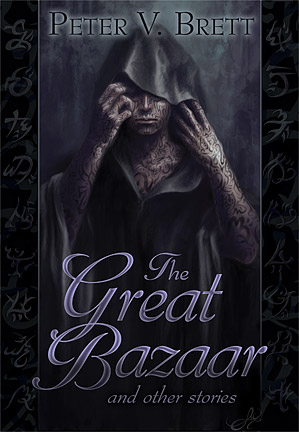
You may remember a very special fan letter Peat received back in December from Penny, the mother of Levi. Levi, a young man with Tourette Syndrome and OCD, is a huge fan of The Warded Man and The Desert Spear, but was unable to purchase Peat’s two other novellas. Peat sent Levi a signed copy of Brayan’s Gold, but was unable to obtain a copy of the elusive Great Bazaar. The novella is currently going for $200 for used copies and $400 for new copies. And while the ebook edition is only $4.99, many people don’t have or don’t want an ereader.

After reading the post about Levi, two brothers were inspired to help Levi out. They wrote Peat with a proposition:

Hello,

I read with some interest your blog post about Penny and her son Levi. It seems from the post that you sent them a copy of Brayan’s Gold. (very generous by the way) I was talking to my brother last night and he reminded me that between the two of us we both have copies of The Great Bazaar. So, short version, if they still need a copy of The Great Bazaar, and you are willing to accept a donated one from me, just let me know how I can help. Thanks for entertaining me. I have read all of your books and enjoyed them very much.

John

Peat responded enthusiastically. The book was sent to Peat’s office where he signed it. I packaged it up and sent it on it’s way. I emailed Penny before it’s arrival, letting her know to check the front door for a surprise. Here is the glowing email I received when Levi finally got his hands on the book!

THANK YOU SOOOO MUCH! Levi sincerely wants to thank you. We will thank Peter’s Fans asap. Thank you again for making a difference. If you could see his face you would know how much this means to him. From the very depths of a mothers heart…I thank you. Thank you for helping him to see the world and the people in it are not as bad as he thought. Words cannot begin to express what it means to see him smile…really smile! May the kindness you give…be returned ten fold.

Penny and Levi

Peat and I would love to thank Michael and John for their amazing generosity and kindness. You guy are awesome!

Posted on February 13, 2012 at 8:00 am by megelizabeth
Filed under Brayan's Gold, Desert Spear, Fans, Great Bazaar, Meg, Warded Man
2 Comments »

Linguistics and Fantasy

Posted by Meg

World-building is a complex process. It is a chance to draw from history of our world and combine it with something unknown. But it is also a struggle to create something fresh yet familiar. To draw upon what is loved about the fantasy genre and to mark your own territory. I think most fans can agree that it’s one of the most fascinating aspects of fantasy.

Peat received an interesting email from a fan (Becca, a linguistics major!) questioning his approach to creating the languages and cultures that appear in The Warded Man and The Desert Spear. Here’s what he had to say:

Hi Mr. Brett,

Becca Gimlett here, linguistics student from California now studying abroad in Berlin, long-time fantasy fan, occasional creeper of your blog, admirer of the contents of your bookshelves. I also enjoyed The Warded Man and The Desert Spear and perhaps stayed up slightly too late on weekdays devouring them, but you’ve probably gotten plenty of those emails before now. You’re also busy, so I’ll leave the praise implied and skip to getting to my question. (No hurt feelings on my part if you’re too snowed to answer. I’ll just go bug Sanderson instead. Kidding, just kidding…)

As you’re probably aware, there’s an unfortunate multitude of people in this world who look down upon or even doubt fantasy as a form of literature, and these sorts tend to congregate in the Humanities departments of colleges and universities. I encounter them all the time, or perhaps they encounter me. Before I began studying linguistics, however, it was easy enough to defend (the potential of) the genre as a form of artistic expression. Ever since that first introductory class, though, it’s become harder to do. I’m sure the fantasy fans who decided to study geology, physics, biology, whatever might have similar problems. While my respect for Professor Tolkien has multiplied, my ability just to enjoy a fantasy book has gone down hill, because that made-up language or that name or that casual statement about consonants that I swallowed beforehand without thinking is now a glaring rip in the patchwork.

Thankfully, the recent trend in fantasy lit nowadays has been for authors to do their research, and the days of blind copy-catting are (crossed fingers!) over. No more languages that look like keyboard smash, no more random mountains, general common sense switched on.

The short version is that your books fell into the “nowadays” category for me when I read them a couple months ago, but in a rather unusual sort of way. Not the “slip past the radar” way but “hey, maybe this Brett dude went through the trouble not just to avoid errors but to actually…get things right?” one. And so, to arrive at long last to my question (apologies for the long-winded lead-up), what sort of research did you do into building the language of the Krasians? Obviously it has some real-world inspirations, but also so deviations, and I’d be interested to know what you decided to change/keep/leave out and why… And, because this is my area of interest (we’re talking, would-do-dissertation-on-the-topic type of interest), what sort of thought went into the naming systems for both cultures? I ask because I don’t know if I should let myself have an all-out linguistics-nerd-out on what you created, or just not question it and plow onward when Daylight War hits the market 🙂 No worries at all if I should just do the latter.

Many thanks for writing some killer fast-paced didn’t-make-me-want-to-mourn-the-future-of-fantasy books. They were my first Kindle reads and will always have a place in my heart. I look forward to a response but understand if that’s not possible. Also, thanks for reading this email!

Tschüss, as the Germans say!

Becca Gimlett

And Peat’s response:

Hi Becca,

Thank you for writing and all the kind words.

To answer your question, I am not a linguistics expert, but having worked as an editor for years and studied Latin and French, I have a fairly good sense of how language is put together. I try not to overwhelm readers with too many Krasian words, but I have been careful to be consistent  in structure with the words I use, showing common roots in the things that are important to Krasian culture. While some effort was made to give the language a Middle Eastern flavor, it is for the most part fabricated.

The Thesan naming system is essentially to use ‘normal’ western names, but alter the spelling, usually to simplify. This was meant to represent the loss of literacy after the Return, when demons burned the libraries. I was inspired in this by Middle English, where the same word can be spelled three different was on the same page.

Thanks again.

Regards,

Peat

Posted on February 10, 2012 at 3:48 pm by megelizabeth
Filed under Craft, Daylight War, Desert Spear, Fans, Germany, Meg, Warded Man
Comments Off on Linguistics and Fantasy